
When Communication Damages Trust Instead of Building It
In a time when information travels instantly, misaligned communication can do more harm than silence. Brands, institutions, and governments often invest in messaging infrastructure press releases, social media, dashboards but fall short on delivery tone and timing. The result: audiences feel ignored, misinformed, or spoken down to. This breakdown isn’t rooted in content, but in carelessness messages that overlook human emotion, urgency, or context. Communication, if delayed, robotic, or vague, erodes credibility.
Defining Care in Communication: It’s More Than Words
Communication as care is not about sentimentality. It is the deliberate use of tone, timing, and language to acknowledge the emotional state of the recipient. This includes clarity under pressure, sensitivity during distress, and consistency during change. In practice, this means understanding that a refund email from a food delivery app is not just about the money it is about how disappointment is handled. A response after a data breach isn’t just about protocol it’s about transparency, empathy, and reassurance.
Learning from the Field: Real-World Examples That Got It Right
When Zomato transitioned from templated support replies to humanised responses with humour and regional language integration, user satisfaction scores improved visibly. Their message tone moved from transactional to conversational. During the Ukraine conflict, Airbnb’s public statements not only clarified their stance but offered immediate relief waiving fees for temporary housing support. The timing and action were simultaneous, which reinforced trust. In the development space, UNICEF’s COVID-19 vaccine campaigns across rural India used hyper-local language, maternal framing, and culturally resonant visuals. The words were simplified, the tone reassuring, and the result: improved vaccine uptake in communities historically sceptical of public health outreach.

Tone Is Not Soft—It’s Strategic
Many organisations mistake professionalism for distance. However, the most effective communication teams understand that tone is not style it’s strategy. Acknowledging a delay, validating a complaint, or choosing inclusive language are not operational niceties. They are interventions. They shift perception and build resilience in the relationship. In community-driven platforms whether WhatsApp-based citizen groups or helplines like the Women Helpline 181—empathy in language defines whether a participant continues to engage or exits the system. The Women Helpline 181 campaign video titled “Women are no longer alone”(“अब महिलाएं अकेली नहीं हैं”) delivers a powerful message through everyday scenarios where women feel unsafe or unheard. The video reinforces that help is just one call away—dialling 181 connects women to immediate support. Its tone is reassuring, direct, and empathetic, showing how strategic communication can reduce hesitation and build trust in public services. Watch here: https://youtu.be/im-Z8-6a_-0
Operationalising Care: Systems, Not Sentiment
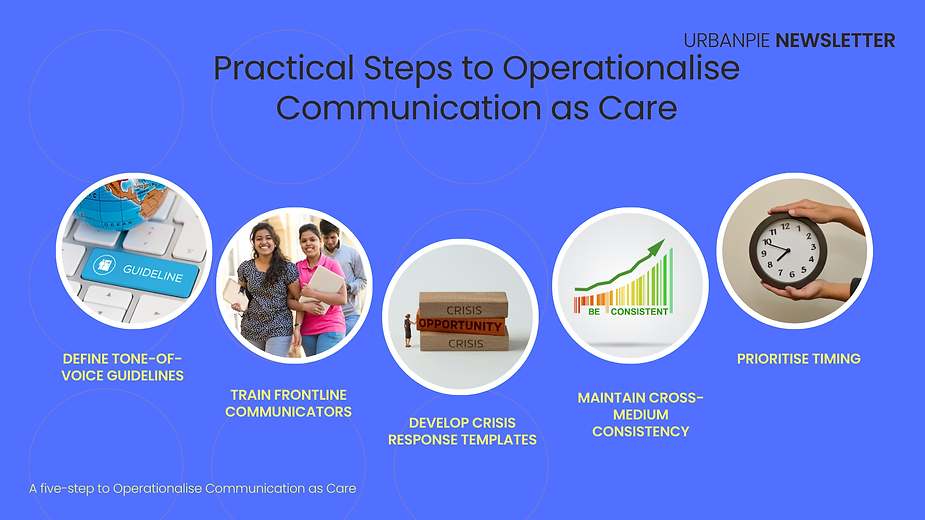
Careful communication cannot be improvised. It must be systematised. This includes defining tone-of-voice guidelines, training frontline communicators, preparing rapid response templates for crises, and maintaining consistent brand language across mediums. Timing also plays a crucial role. The effectiveness of a message declines sharply when it comes too early, too late, or without follow-up. Internal comms in companies like Swiggy, for instance, now include mental health check-in prompts during restructuring updates a signal that communication is not just operational, but relational.
Community Spaces Demand Higher Communication Standards
“In grassroots movements and user-led platforms, the absence of clear and empathetic communication leads to fragmentation.”
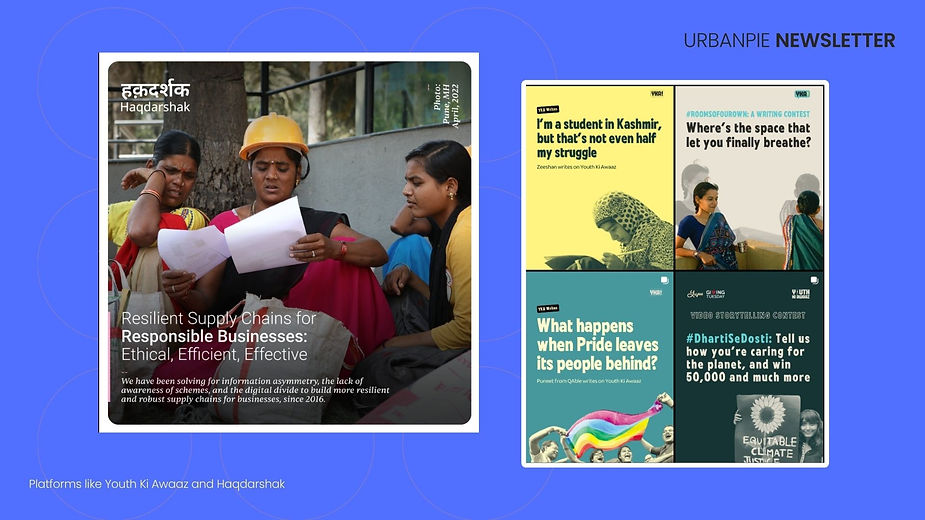
Volunteer groups working on menstrual health or disaster relief often cite message overload, lack of acknowledgement, or poor clarity as reasons for disengagement. Conversely, when platforms like Youth Ki Awaaz or Haqdarshak embed local narratives, voice notes, and visual cues, they maintain cohesion—even in distributed teams.
From Messaging to Meaning-Making
Ultimately, communication as care shifts the focus from information dissemination to meaning-making. It centres the audience’s emotional and situational context not just the sender’s intention. Whether it’s a food-tech company resolving a complaint or a helpline responding to a flood-affected community, how something is said is as important as what is said. In the long term, consistency of care not just correctness of facts defines who gets heard and who is trusted.
Key Takeaways
Organisations must view communication not as an announcement function but as a care system. Audiences may forget what was said, but they rarely forget how it made them feel. In environments of fatigue, crisis, or transition tone, timing, and clarity are not optional. They are decisive.
- Poor tone or delayed communication weakens audience trust, regardless of content accuracy.
- Strategic communication includes empathy, response time, and contextual language.
- Case examples from Zomato, Airbnb, UNICEF, Swiggy, and Haqdarshak illustrate effective tone-led strategy.
- Internal and external comms must be trained, templated, and timely.
- Community engagement depends not just on content quality, but how that content is delivered.
Words shape perception. Tone builds trust. Timing determines relevance. Organisations that treat communication as care define tone-of-voice guidelines, train frontline communicators, develop crisis response templates, maintain cross-medium consistency, prioritise timing—build not just audiences, but resilient communities.
Frequently Asked Questions (FAQs)
1. What does ‘communication as care’ mean in a professional context?
It refers to intentional messaging that prioritises empathy, clarity, and responsiveness—particularly during moments of uncertainty or user distress. It involves not just what is communicated, but how and when it is delivered.
2. Why is tone important in community engagement?
Tone influences how messages are received. A respectful, clear, and empathetic tone builds trust and signals attentiveness. Poor tone can alienate audiences, even if the core message is accurate.
3. How can organisations systematise empathetic communication?
By developing tone-of-voice guidelines, preparing response templates, training teams in emotional literacy, and ensuring messaging is reviewed through the lens of the audience’s likely emotional state.
4. Can large-scale platforms maintain empathetic tone at scale?
Yes. Platforms like Zomato and Airbnb have shown that automation and empathy are not mutually exclusive. Regional language integration, humour, and timely responses can be standardised with the right workflows.
5. What role does timing play in effective communication?
Timing affects relevance and trust. Messages delivered too late may be perceived as evasive; messages delivered too early, without context, may cause confusion. Ideal timing matches both need and readiness of the audience.
6. How does communication style affect volunteer or grassroots networks?
Lack of clarity or acknowledgement can demotivate community members. Conversely, personal responses, voice notes, and inclusive phrasing—as used by platforms like Haqdarshak—promote sustained engagement in distributed teams.
Add a Comment